Kaypro 1 (81-021): Difference between revisions
FrankRahman (talk | contribs) (→News) |
FrankRahman (talk | contribs) No edit summary |
||
| Line 4: | Line 4: | ||
The Kaypro 1 was actually the last CPM based Kaypro introduced. Mostly it was marketed to serve as an inexpensive word processor. Most of the parts used were likely surplus parts that Kaypro needed to clear out of the warehouse. | The Kaypro 1 was actually the last CPM based Kaypro introduced. Mostly it was marketed to serve as an inexpensive word processor. Most of the parts used were likely surplus parts that Kaypro needed to clear out of the warehouse. | ||
==Universal Board Changes?== | |||
<blockquote> | |||
Dr. Yates, that your Kaypro 10 motherboard is similar to my Kaypro 1 motherboard. Even if not, what follows may be of use. ... | |||
What's important is that this is probably the final version of their universal board. It incorporates certain changes (upgrades?) which don't appear on the Micro C schematic and are not documented in any articles. | |||
As you probably know, the Kaypro 1 is really a 4-84 without the parts for the clock, modem, and SASI. So I decided to install the missing parts and document any differences between my board and the Micro C schematic. Enclosed are my efforts to date. (See Figure 1.) I believe I've covered most, if not all, of the differences. | |||
[[File:Micro Cornucopia Nov88 pg 81 K1 schem.jpg|600px]] | |||
(Micro Cornucopia, Nov-Dec 1988) | |||
</blockquote> | |||
==News== | ==News== | ||
Latest revision as of 12:47, 23 October 2026


The Kaypro 1 was actually the last CPM based Kaypro introduced. Mostly it was marketed to serve as an inexpensive word processor. Most of the parts used were likely surplus parts that Kaypro needed to clear out of the warehouse.
Universal Board Changes?
Dr. Yates, that your Kaypro 10 motherboard is similar to my Kaypro 1 motherboard. Even if not, what follows may be of use. ...
What's important is that this is probably the final version of their universal board. It incorporates certain changes (upgrades?) which don't appear on the Micro C schematic and are not documented in any articles.
As you probably know, the Kaypro 1 is really a 4-84 without the parts for the clock, modem, and SASI. So I decided to install the missing parts and document any differences between my board and the Micro C schematic. Enclosed are my efforts to date. (See Figure 1.) I believe I've covered most, if not all, of the differences.
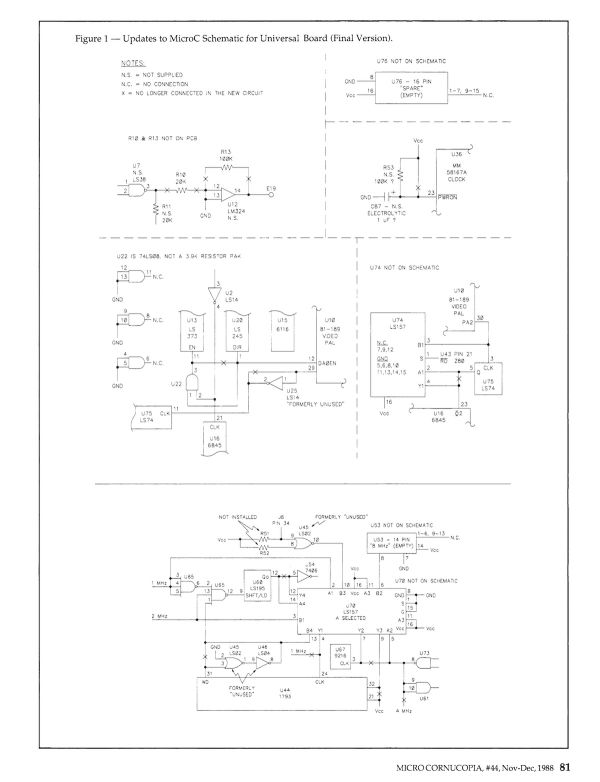
(Micro Cornucopia, Nov-Dec 1988)

News
"Another new Kaypro is the Kaypro 1. It is being marketed primarily for use as a word processor, or as a terminal or front end for mainframe communication. It has two vertical disk drives and is bundled with CP/M and Perfect Writer. The cost of this machine is $995." (Kugram Vol.3 No.4)
The Kaypro 1 is a "bare bones" CP/M machine and is the most economical model in the Kaypro line. It comes with two 392K double-sided drives but does not have a real-time clock or internal modem.
In keeping with its "bare bones" approach, software bundled with the Kaypro 1 is minimal. Included with this entry-level Kaypro are Perfect Writer and CP/M 2.2 with the standard Kaypro utilities.
In addition to the basic Kaypro 1 , a "Kaypro 1 word processing system" is being offered for a limited time. This system is a Kaypro 1 combined with a Gemini dot-matrix printer and is being offered for the same price as the standard Kaypro 1.
(Profiles, January 1986)
"The Kaypro Corporation sends news of the passing of a couple of old friends, the Kaypro 1 and the Kaypro 10. The decision to send old No. 1 to the glue factory will sadden many CP/M followers who fondly remember 'Darth Vader's lunch bucket.'"
(New York Times, February 11, 1986)
"I bought a Kaypro 1 in December of last year
from a liquidator. The production tag indicates
that the machine was produced in November
1986, and I suspect that Kaypro made a final
run to clear out its parts inventory."
(Micro Cornucopia, Nov-Dec 1988)